How It Works
Every Factory token follows the same lifecycle: it's created against a virtual reserve, trades on a constant-product bonding curve until 2.36 ETH is bonded, then graduates into a locked Algebra V4 position on Cypher's AMM.
Lifecycle
The bonding curve
The Factory uses a constant-product bonding curve. Price is set automatically against a running supply and a virtual ETH reserve - the more tokens have been bought, the steeper the curve.
x · y = k
Every Factory token launches with the same shape:
- Max supply: 1,000,000,000 (1B) tokens.
- Curve supply: 800M tokens (sold through the curve).
- LP reserve: 200M tokens (held back for graduation).
- Virtual reserves: ~0.591 ETH.
- ETH raised at graduation (post-fee): ~2.36 ETH.
That gives a launch market cap of $1.3K and a graduation market cap of $34K (at ETH = $2,300), with a 25× price multiple from first buy to last buy.
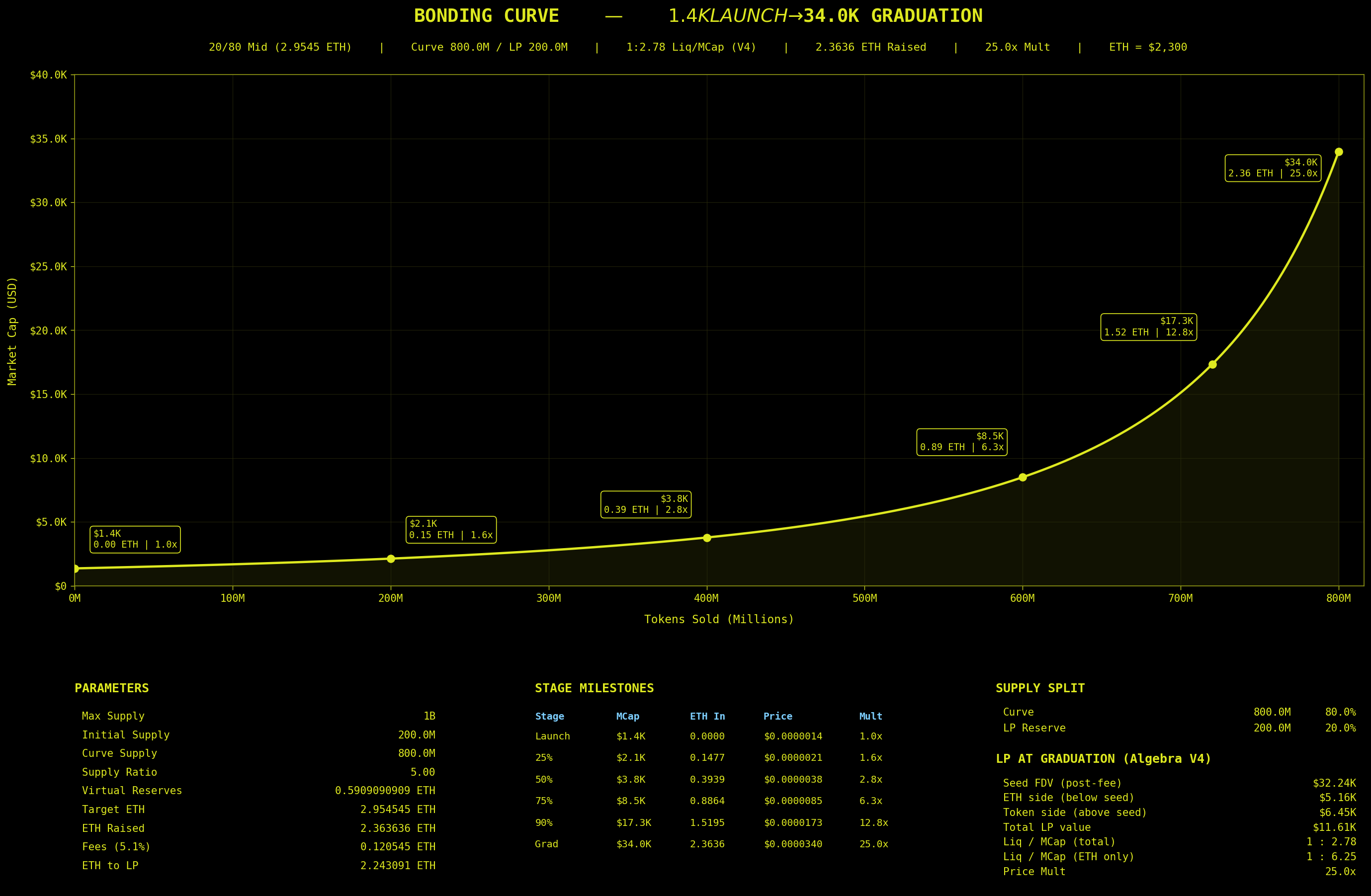
Stage milestones
| Stage | Tokens sold | MCap | ETH in | Multiple |
|---|---|---|---|---|
| Launch | 0 | $1.3K | 0.00 | 1.0× |
| 25% | 200M | $2.1K | 0.15 | 1.6× |
| 50% | 400M | $3.8K | 0.39 | 2.8× |
| 75% | 600M | $8.5K | 0.89 | 6.3× |
| 90% | 720M | $17.3K | 1.52 | 12.8× |
| Graduation | 800M | $34K | 2.36 | 25× |
The curve is convex: early buyers pay deeply discounted prices, and the bulk of the price action happens in the last quarter of the curve supply.
Three phases of a token
1. Pre-graduation (the curve)
The token only trades through the bonding curve. Transfers are restricted to a small allow-list (the Factory and the optional vesting contract), so the supply cannot be moved peer-to-peer or burned before liquidity exists.
Every trade pays a 1.5% trading fee on the ETH leg. If the buyer arrived via a referral link, part of that fee is split with the referrer (see Referrals). Otherwise the full fee accrues to the Protocol.
2. Graduation
The first buy that pushes the token to its max supply triggers graduation in the same transaction. In one atomic step the token:
- Wraps the accumulated curve ETH into WETH.
- Pays the graduation fees - 0% Protocol, 5% Creator, 0.1% refund to the wallet that triggered graduation (see fees).
- Forwards the remaining ETH plus the 200M LP reserve to the Liquidity Manager.
- Two concentrated Algebra V4 positions are minted per pool (95% in the custom pool, 5% in the default POL pool when enabled). The LP NFTs are sent to Harvester, where they're permanently locked.
- The pre-LP transfer restrictions are lifted. From this point on, the token behaves like any standard ERC20.
3. Post-graduation (locked v4 LP)
Trading moves to Cypher's Algebra V4 AMM. Swaps pay a dynamic, volatility-adjusted fee distributed between the Protocol, the optional Staking Vault, and the configured Fee Receiver. See Liquidity & graduation for the full split.
Why a virtual reserve?
A pure constant-product curve starting from zero reserves would give wildly unstable prices on the first few buys. The Factory seeds the curve with a virtual ETH reserve (~0.591 ETH) that exists only for pricing. It is never withdrawable. What it gives you is:
- A defined initial price (the launch market cap of $1.3K).
- A smooth curve from the very first transaction.
- A predictable graduation point at ~2.36 ETH of real ETH raised.
The total fee burden across the lifetime of the curve is ~5.1%, which is what reconciles the ~2.95 ETH target the curve is computed against with the ~2.36 ETH users actually pay in.